The twenty-fourth Session of the IOC Assembly (19-28 June 2007) adopted the IOC Strategic Plan for Oceanographic Data and Information Management through Resolution XXIV-9.
The Document can be downloaded in PDF format (1.4 MB)
For bibliographic purposes this document should be cited as follows:
IOC Strategic Plan for Oceanographic Data and Information Management (2008-2011). Paris, Intergovernmental Oceanographic Commission of UNESCO, 42 pp.
(IOC Manuals and Guides No. 51) (English)
© UNESCO 2007
The IOC Data and Information Management Strategy will deliver the following:
- process and archive data on a diverse range of variables according to scientifically sound and well-documented standards and formats;
- distribute data on a diverse range of variables (observations and model outputs) in both real time and in “delayed” modes depending on the needs of user groups and their technical capabilities (automatic dissemination as well as “on demand”); and
- enable efficient access to data on core variables and derived products (including forecasts, alerts and warnings) by users who have a broad range of capabilities.
The guiding principles against which the Data and Information Management Strategy will be assessed include: (i) adherence to relevant data policies (including data provision to all member states), (ii) development of, and access to, products and services, making the best use of appropriate technology, (iii) capacity building, (iv) inclusion of National Oceanographic Data Centres (NODCs), specialised oceanographic data centres (such as those associated with, for example, Argo, GTSPP and the drifting buoy programme) and regional data centres, (v) project data management elements and (vi) collaboration with other relevant groups.
The IOC Data and Information system will, like that of the Global Earth Observing System of Systems (GEOSS), be a system of systems. Each of these should be an end-to-end system, handling data from the point of collection, through processing and quality control, to archival and dissemination. There is no “one size fits all”, but by use of standards interoperability between the systems can be achieved. As noted by GEOSS in its Implementation Plan, the informal definition of interoperability is very useful in scoping the problem: “What few things must be the same so everything else can be different.” Increasingly standards are available, which have been designed elsewhere but which are applicable to ocean or marine data. These include those developed by the International Organization for Standardization (ISO), the World Wide Web Consortium (W3C) and the Open Geospatial Consortium (OGC).
The major elements of the Strategy are:
- Adherence to the IOC Oceanographic Data Exchange Policy;
- Governance by a management committee, aided by a technical task team, supported by data and information coordination units;
- A permanent long-term data archiving centre for all data, which operates to agreed standards;
- Recommended best practice for quality control, documented and made easily accessible and available;
- Acceptance and implementation of a set of interoperability arrangements, including technical specifications for collecting, processing, storing, and disseminating shared data, metadata and products;
- Interoperability between the different end-to-end systems for IOC data and with other systems (e.g. GEOSS, International Council for Science (ICSU), International Council for the Exploration of the Sea (ICES), Census of Marine Life (CoML)/Ocean Biogeographic Information System (OBIS), US Integrated Ocean Observing System Data Management and Communications (IOOS DMAC) system, SeaDataNet, etc.) through the use of service oriented architecture;
- To continue to develop Ocean Data and Information Networks (ODINs) backed up by OceanTeacher as a capacity building tool, whilst extending OceanTeacher through cooperation with WMO, JCOMM and others as appropriate;
- Development of appropriate metrics to help evaluate the data and information system; and
- Facilitation of proper citation of data sets by providing all the required elements of a citation including an unambiguous, unchanging reference.
Communication and outreach must be a key element in the Data and Information Strategy, which will be addressed at various levels. Communication within and between IOC programmes, and with IOC’s partners, is essential to ensure that a fully integrated data system rather than the current multitude of systems results. But IOC does not exist in isolation and cooperation and collaboration with other organisations with similar interests and goals is essential. Participation in meetings of other organisations undertaking similar initiatives and dissemination of information via the internet are both essential methods of communication and outreach. Information about the IOC Data and Information Strategy, its development, data centres, standards, and implementation progress must be made available in an easy to understand form.
There are many IOC and IOC-related programmes and projects with a data management component. Presently there are also many mechanisms to coordinate the various individual ocean and marine data systems. Whilst these are essential to the continued operation of data management and exchange of the various data streams, an overarching coordination must be put into place to encourage adoption of standards, protocols, technologies, etc. IODE and the JCOMM Data Management Coordination Group (DMCG) should coordinate this effort, through the suggested Data and Information Management Advisory Group, and develop the implementation plan, building on the existing expert groups and continuing close links with groups external to IOC. See below the organogram of the IOC data and information management system with the central IOC data and information management advisory group that will bring together the various programme elements of IOC as well as of bodies and organizations collaborating closely with IOC.
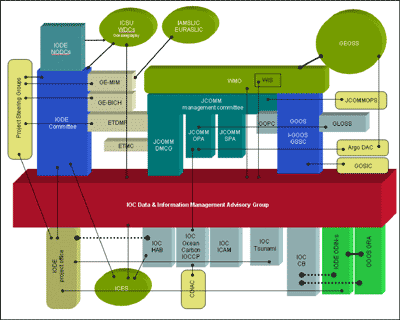
There are many initiatives which are making progress on the goals identified. This includes the development of the ISO19115 marine community profile for metadata and work on developing common vocabularies and ontologies. Increasingly there are moves towards service-oriented architecture and use of W3C, OGC and ISO standards. These should be continued. Further work is necessary on quality control. New technical groups may be required to solve some of the issues raised. Data assembly and archiving centres must be strengthened and properly resourced. A suite of metrics needs to be developed to enable assessment of the progress of the overall system and some over all data information unit or centre established, building on those which already exist.
The IOC Data and Information Management Strategy will build on existing systems, and will make every attempt not to re-invent the wheel. A fundamental concept is that, like GEOSS, the ocean or marine “system of systems” must be built on existing systems and initiatives with sufficient flexibility to encompass future systems.
The greatest challenge to be faced in developing and implementing the IOC Data and Information Management Strategy is one of coordination and cooperation among member countries, partners and user communities. There are currently still major barriers to the efficient use and re-use of data and to overcome these, and make the best use of the new technologies available, a culture change is required. The information technology required to meet most of the requirements of the strategy, whilst challenging, can be developed from existing capabilities through relatively straightforward software engineering. But the strategy will only succeed if all participants devote increased resources to cooperation, actively use the data and metadata standards, communications protocols, software, and policies that will knit the parts into an integrated whole.
OCEAN DATA PORTAL
The IODE is developing the Ocean Data Portal to facilitate and promote the exchange and dissemination of marine data and services. The Ocean Data Portal will provide seamless access to collections and inventories of marine data from the IODE NODCs and other data centres in the network and will allow for the discovery, evaluation (through visualisation and metadata review) and access to data via web services. The system architecture will use Web-oriented information technologies to access non-homogeneous and geographically distributed marine data and information.
The Ocean Data Portal will be developed in close cooperation with existing and developing initiatives such as the IODE/JCOMM E2EDM Pilot Project, SeaDataNet, WIS, Australian Oceans Portal, IOOS, Russian ESIMO and others. The Ocean Data Portal will also support the data access requirements of other IOC programme areas, including GOOS, JCOMM, HAB and the Tsunami warning system. The Ocean Data Portal development will also work closely with other international initiatives including WIS and GEOSS to ensure interoperability with other domains.
The Ocean Data Portal will deliver a standards-based infrastructure that provides the integration of marine data and information from a network of distributed IODE NODCs as well as the resources from other participating systems. More information on the OceanDataPortal is available HERE
Latest News
The IODE Programme Component, OceanTeacher Global Academy is seeking a consultant for 8 months
Please find the requirements here
This contract would run from 15 April until 15 December 2024.
Deadline to apply is 31st March 2024 Extended till 7 April 2024- contact point: Mr Peter Pissierssens (This email address is being protected from spambots. You need JavaScript enabled to view it.) and This email address is being protected from spambots. You need JavaScript enabled to view it.
OBIS has a key role in several new projects that use eDNA or aim to further improve this technology for biological monitoring and we are glad to announce that we now have two knowledgeable staff members in our OBIS secretariat who are experts in eDNA: Dr Emilie Boulanger (consultant) and Dr Saara Suominen (project appointment).

Dr Saara Sumominen, after more than 3 years working as a consultant for us with projects like PacMAN and eDNA expeditions, now joined the OBIS secretariat on a project appointment contract basis to help implement 3 Horizon Europe projects (Marco-Bolo, eDNAquaPlan and DTO-BioFlow), coordinate the final scientific report of eDNA expeditions in UNESCO marine world heritage sites, and further develop the capacity to manage eDNA projects at OBIS.
Saara can be reached by email at This email address is being protected from spambots. You need JavaScript enabled to view it.
More information on Saara's background see: https://obis.org/2020/09/15/saara/

Dr Emilie Boulanger joined us as a consultant and will support us with implementing two Horizon Europe projects: Marco-Bolo and eDNAquaPlan. Some of these tasks include (i) reviewing protocols and SOPs utilized for eDNA monitoring, (ii) testing bioinformatic workflows and comparing outputs across marker and taxonomic types, (iii) establish standards for genetic reference libraries and eDNA data repositories, (iv) aligning databases for enhanced interoperability, and (v) addressing the infrastructure and services for aquatic biodiversity monitoring using eDNA.
Emilie has a background in biodiversity conservation and marine molecular ecology. For her PhD at the University of Montpellier, her work focused on applying molecular methods to study the genetic and species diversity of fish populations and communities in the Mediterranean Sea. During her following PostDoc experience at the Aix-Marseille University, she applied her research experience towards teaching as well as developing monitoring projects coupling environmental DNA metabarcoding with direct species observations. She is passionate about the ocean, knowledge dissemination and projects that bridge scientific innovation with environmental conservation and policy.
Emilie can be reached by email at This email address is being protected from spambots. You need JavaScript enabled to view it.

We received the news that Dr J.R. Wilson (Ron) has passed away.
Dr J.R. Wilson was Director of the Marine Environmental Data Service of the Canadian Department of Fisheries and Oceans. He was IODE Chair between 1992 and 1996 and chaired the 15th Session of the IODE Committee held in Athens, Greece. Dr Wilson was also GTSPP Project Leader and MEDS hosted the RNODC for drifting buoy data. Many of us remember Ron as a kind and very experienced colleague, always ready to advise and assist.
We offer our condolences to Ron's family.
(picture of the IODE-XV Session with Ron behind the Chairman IODE sign)
The IODE management group meeting took place in Oostende, Belgium from 5-7 February 2024. The Summary Report is now available : https://oceanexpert.org/document/33860
background documents and presentations are available on https://oceanexpert.org/event/3991#overview

The following items were discussed during this 2.5 days meeting: the action points of the XVII meeting, the status of the IODE network , the restructuring of the IODE elements , the IODE Quality Management Framework, the different Programme elements achievements in the past year , the collaboration with other entities, IODE role in the UN Decade and new possible initiatives to come.
OBIS is taking part in an EU-funded project, MARCO-BOLO (MARine COastal BiOdiversity Long-term Observations) which aims to structure and strengthen European coastal and marine biodiversity observation capabilities.
The main objective is to enable a digital framework for coastal and marine biodiversity data streams and data access. This will be done by building on international standards and approaches to establish the biological component of the marine
and coastal Earth observation Infrastructure in Europe. One of Marco-Bolo’s main aims is a more effective knowledge transfer and uptake of data and information products through the establishment of a stakeholder community and close engagement through co-design/co-creation workshops.
UNESCO-IOC is seeking an individual consultant to assist with the coordination of the Marco- Bolo project and more specifically the work related to Work Package 6 “Stakeholder Engagement and Community Integration”.
more information: HERE
Deadline to apply: 23 February 2024 (23: 59 CET)
contract start: 7 March 2024 - 75 %