IODE's regional programme focuses on capacity building related to oceanographic data and information management. IODE has a long history of capacity building and was in fact the first IOC programme that started training courses in the 1960s.
In the late 1980s IODE started the development of a totally new approach which was aimed at organizing capacity building in a regional context and on a long-term basis (at least several years). This led to the development of severeal projects in Africa: (i) RECOSCIX-WIO (Regional Cooperation in Scientific Information Exchange in the Western Indian Ocean region) aimed at development of marine libraries and information centres in Eastern Africa; (ii) ODINEA (Ocean Data and Information Network for Eastern Africa) aimed at developing ocean data management capacity in Eastern Africa; (iii) RECOSCX-CEA (Regional Cooperation in Scientific Information Exchange in the Central Eastern Atlantic) aimed at development of marine libraries and information centres in Western Africa. The merging of RECOSCIX-WIO, RECOSCIX-CEA and ODINEA led to the implementation of the first ODINAFRICA-I (Ocean Data and Information Network for Africa, First Phase) between 1999 and 2001, followed by ODINAFRICA-II (extension of ODINAFRICA-I) between 2002 and 2004, both funded mainly by the Government of Flanders (Kingdom of Belgium). Although initially aimed mainly at ocean data and information management, the ODINAFRICA projects soon identified to work in a more result-oriented fashion, linking with ocean observations and ICAM.
The experience with the above projects resulted in the development of the IODE ODIN capacity building model which is based upon the following 4 guiding principles:
- Linking training, equipment, operational support: provide not only equipment but also training as well as some financial support to operate the equipment and develop products;
- Regional context: focus on national requirements but also identify similar needs across a region and develop regional products and services that serve all participating countries in a region;
- Product and service oriented: do not develop data centres as isolated facilities but ensure these centres provide services and products that are needed by users;
- Multi-stakeholder approach: ensure that the project is driven by stakeholders as representatives of users and involve these stakeholders as much as possible in the governance of the project.
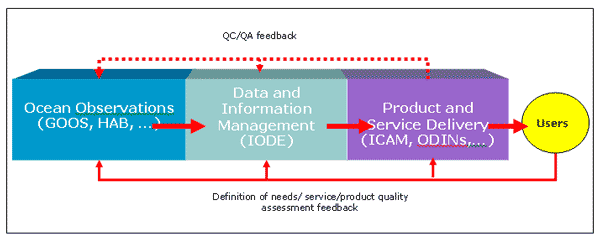
In addition the ODINs apply the end-to-end model that is now a core objective of the IODE programme and is illustrated below:
These 4 guiding principles have been used as from 2005 in all
IODE regional capacity building projects:
- ODINAFRICA-III
(Ocean Data and Information Network for Africa): started 2004
See also African Marine Atlas and ODINAFRICA Sea Level Data Facility
- ODINCARSA
(Ocean Data and Information Network for Latin America and the Caribbean): started 2004
- ODINCINDIO
(Ocean Data and Information Network for the Central Indian Ocean): started 2005
- ODINECET (Ocean Data and Information Network for European Countries in Economic Transition) : started in 2007
- ODINWESTPAC
(Ocean Data and Information Network for the WESTPAC region): started 2007
- ODINBlackSea
(Ocean Data and Information Network for the Black sea region): started 2007
It is further noted that all ODIN projects use the OceanTeacher training system for the oceanographic data and information management training courses. Many of the courses are organized, since 2006, at the IOC Project Office for IODE in Oostende, Belgium.
- Details
-
Created on: Saturday, 16 December 2006 18:41
-
Last Updated on: Thursday, 25 September 2014 15:48