by Peter Pissierssens, Head IOC Project Office for IODE
The International Conference "50 Years of Education and Awareness Raising for Shaping the Future of the Oceans and Coasts" was held in St Petersburg, Russian Federation between 27-30 April 2010. Due to the volcanic eruption in Iceland the previous weeks the number of international participants was less than expected but nevertheless the Conference was a success and resulted in a few important conclusions related to IODE's training and education activities.
The
Conference’s objective was to come forward with a number of recommendations
related to the topic of the 5 panels: (Panel 1) Role of international
organizations in fostering and improving
education and training services to society in the area of environmental
sciences I was invited to present a Presentation; (Panel 2) Present and future
of education and training development in the area of marine sciences with the
attention to the role of science in sustainable development and related issues;
(Panel 3) Educational technology and modern methods of education for the
development of national and regional potential for the support of marine
sciences and observations; (Panel 4) Management and funding of educational and training
processes; and (Panel 5) Awareness raising of the importance of marine research
and protection of marine environment on a scientific basis. To reach this
objective the participants in the Conference were invited to participate in one
of the 5 panels. Prior to the meeting in Panels the Chair of each Panel (I was
one of them) were invited to introduce the Panel through a relevant
Presentation. The title of my presentation was “OceanTeacher: a versatile tool for ocean data and information
management training”.
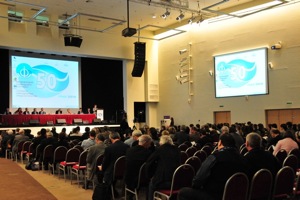
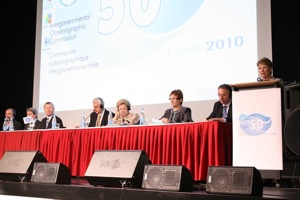
(Photos: top: Dr Wendy Watson-Wright, IOC Executive Secretary opening the Conference; Fig left: view of the plenary Conference room)
After
the Conference split into panels a number of related presentations were
then
made to further focus on the topic to be addressed by the panel. For the
panel
which I Co-Chaired with Dr Podgayskiy (Panel 3) a total of 21 papers had been submitted.The
subsequent discussions by the Panel resulted in the following observations and
recommendations which were presented to the Plenary on the final day of
the
Conference:
The
questions that were addressed by my Panel were the following:
1.What are
the key issues for Education and Training in international oceanography
and
marine meteorology in the next 10 years?
2.How can
distance learning/information & communication technology (ICT) help
us to
address these issues?
3.Where are
the gaps?
The
Panel answered these as follows:
1.What
are the key issues for Education and Training in international
oceanography and
marine meteorology in the next 10 years?
The meeting welcomed the
integration of the
oceanography and meteorology data streams by connecting the WIS and the
IODE
OceanDataPortal distributed data systems;
The meeting recommended
increased joint
training in data management as well as operational services;
The meeting recommended our
communities to
become active partners in the “global commons”;
IOC and JCOMM should create an
equivalent to
WMO 258, i.e. a reference document that outlines basic academic requirements
and operational competencies. This would support the introduction of a
QMF at a
future stage;
The meeting called for the
development of a
QMF and related accreditation of lecturers and courses, and called on
Governments to recognize the completion of the courses as essential for
CPD.
2.How
can distance learning/information & communication technology (ICT)
help us
to address these issues
Agree to use multiple
interoperable DL
platforms (what is out there now?), Moodle (+ synchronous training
tools)
Need to encourage
institutions/communities to
make available teachers/ teaching time
3.Where
are the gaps?
Teacher training (including
pedagogical and
technical) in DL is needed – take into consideration “lecturer skills
divide”
Need to stress importance of
expertise
sharing
Uncertainty: Unpredictable
digital divide
Uncertainty: move to regional
infrastructure
rather than national – political uncertainty
Cultural change: Institutional
management/
government must recognize DL as valid capacity development mechanism
Resources: development of DL
material is
costly but makes optimal use of expert’s time and will be less costly
than
repeated training due to staff turnover and brain drain + rapid
technological
change can be adopted more quickly + distributed work forces can be
addressed
simultaneously
Recommends
to develop:
Inventory
of (free) Academic/Degree DL courses/modules?
inventory
of (free) Technical Training courses/modules?
inventory
of school/public info training materials
inventory
of (free) Digital Libraries
Establish coordination with new “content carriers” (GEONETcast,,…) to assist with delivering content
WMO and IOC will focus mainly on higher education and technical training. Partnerships should be established with other organizations (such as IOI) to address public awareness/training of general public, other practitioners and schools


 Oceans and Coasts" was held in St Petersburg, Russian Federation between 27-30 April 2010. Due to the volcanic eruption in Iceland the previous weeks the number of international participants was less than expected but nevertheless the Conference was a success and resulted in a few important conclusions related to IODE's training and education activities.