WHAT is Aquatic Sciences and Fisheries Abstracts (ASFA) ?

The Aquatic Sciences and Fisheries Information System (ASFIS) is an international co-operative information system for the collection and dissemination of information covering the science, technology and management of marine, brackishwater, and freshwater environments.

The Aquatic Sciences and Fisheries Abstracts (ASFA) Bibliographic Database is the principal information product of the ASFIS system. It contains approximately 1 million bibliographic references (or records) to the world's aquatic science literature accessioned since 1971 (for some journals and/or subject areas the coverage precedes 1971). All references are machine readable.

inf0994.gif

Find outmore about the history of ASFA

ASFA: the first twenty years; an outline history of Aquatic Sciences and Fisheries Abstracts, 1971-1990
Publ Year: 1995
Author: Varley, Allen
70 p., illus.
Document code: IOC/INF.994

How can I access ASFA?

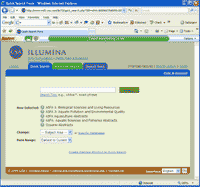
General Public: Access to the ASFA Bibliographic Database, by the General Public, is available through subscription from the commercial ASFA Publisher CSA - more particularly its Illuminacsa_illumina.gif service - or from one of the CSA licensed providers (NISC , DIALOG, STN International (online))

Low Income Food Deficit Countries (LIFDC): There is a FAO/ASFA project initiative underway to provide free access to the ASFA Bibliographic Database to selected institutes in LIFDC countries. See section-1, below, for a brief description of this initiative (for a detailed description including instructions on “how to apply” for access to the ASFA Bibliographic database under this initiative see FAQ-9 (ftp://ftp.fao.org/FI/asfa/faq/faq9_e.pdf ) .

ASFA Partner institutes/organizations: By rule, access to the ASFA Bibliographic Database by participating ASFA Partner institutes/organizations is free.

How is ASFA produced?

ASFA is produced as a cooperative effort by the international network of ASFA Partners (http://www.fao.org/fi/asfa/partners.asp) which consists of: United Nations Co-sponsoring Partners, National and International Partners, and the Publishing Partner. The objective is to disseminate bibliographic information to the world community. All ASFA Partners sign the ASFA Partnership Agreement (http://www.fao.org/fi/asfa/agreemt.asp ) and are represented on the ASFA Advisory Board (http://www.fao.org/fi/asfa/agreemt.asp#ArticleVIII) which meets annually and for which FAO provides the Secretariat (http://www.fao.org/fi/asfa/agreemt.asp#ArticleIX ).

Input to the ASFA Database (i.e. the bibliographic references) is prepared by the international network of ASFA Partners, who are together responsible for the monitoring of more than 5000 serial publications (ftp://ftp.fao.org/fi/asfa/Monitoring_List/ASFISIS_update/master.txt ) as well as books, reports, conference proceedings, and grey literature. The collective input of the Partners is sent to the Publisher of ASFA (CSA) (http://www.fao.org/fi/asfa/csapartn.asp) where it is processed by computer and merged to create a master file (which we call the ASFA Bibliographic Database).

From the master file, the ASFA Information Products (http://www.fao.org/fi/asfa/asfa.asp#ASFAP) are produced. They are distributed or made available to the ASFA Partners on a monthly/quarterly basis in the form of printed abstracts journals (e.g. ASFA-1, ASFA-2, ASFA-3) and in machine readable format (e.g. Internet access, CD-ROM, Magnetic tape) for use as a source of data in local, national or regional information services.

The Bibliographic Reference or record describing each document in the ASFA database contains: a detailed bibliographic citation, an abstract(s), and a set of indexing terms.

During the preparation of the bibliographic reference, it is the responsibility of the ASFA Partners: to identify the data elements making up the bibliographic citation, to write/edit the abstract, and to choose the indexing terms.

To assist the ASFA Partners in the preparation of input (that is to ensure the consistency necessary for the computer processing and the uniformity within the resulting ASFA information products) standardized cataloguing, abstracting and indexing procedures have been prepared and published under the title of the ASFIS Reference Series. (http://www.fao.org/fi/asfa/asfa.asp#ASER)

FAO/ASFA Low Income Food Deficit Country (LIFDC) Project

The FAO/ASIA project initiative to supply the ASFA Bibliographic Database (free of charge) to institutes in Low Income Food Deficit Countries (LIFDC) is an attempt to provide access to the ASFA database to those Institutes that cannot join ASFA and/or that cannot afford the commercial subscription price to ASFA. Eligibility to benefit from this project initiative is limited to institutes in LIFDC countries (http://www.fao.org/countryprofiles/lifdc.asp?lang=en ).

The project began in 1999 and was originally limited to providing only the ASFA CD-ROM to institutes only in Africa. The project was subsequently enlarged to include all LIFDC countries and also to include access to the ASFA database via Internet (albeit many LIFDC countries institutes do not have the necessary internet connectivity).

Initial contact with institutes was made by mailing these institutions an information sheet giving details of the initiative and requesting interested institutions to complete a questionnaire (see FAQ-9 -
ftp://ftp.fao.org/FI/asfa/faq/faq9_e.pdf ).

For institutes in LIFDC countries in Africa, the number of institutions accessing ASFA under this initiative is currently 38.

For the rest of the world ASFA LIFDC project, including both those receiving ASFA on CD-ROM and those receiving it via Internet, the total number of recipients (other than Africa) is currently 13.

It should be noted that a number of Institutes (7 to date), as a result of this project, have joined the ASFA Partnership (i.e. they submit ASFA bibliographic references to the ASFA database for the aquatic science literature published in their country. In return, they receive the ASFA information products as a result of their membership in ASFA and not as a result of the LIFDC project).

For details on how to apply for access to the ASFA Bibliographic Database through the FAO/ASFA LIFDC project initiative see FAQ-9 (ftp://ftp.fao.org/FI/asfa/faq/faq9_e.pdf )

Involvement of IOC/IODE in ASFIS/ASFA

The Intergovernmental Oceanographic Commission of UNESCO's IODE programme is one of the 4 United Nations Co-sponsoring Partners (more info on ftp://ftp.fao.org/FI/asfa/asfa_partner_list.pdf ).

IOC/IODE's support to ASFA has consisted of promoting the establishment of ASFA national input centres in developing countries (eg through the ODIN projects), assist with the organization of ASFA input training courses, providing support for developing countries to participate in meetings of the ASFA Advisory Board, advocating free or affordable access by developing countries to the ASFA data base, and promoting the input of publications by scientists from developing countries (including grey literature) in ASFA.

IOC/IODE participates in the annual ASFA Advisory Board Sessions (see more on the Sessions and their reports on http://www.fao.org/figis/servlet/static?xml=asfa_prog.xml&dom=org&xp_nav=5.

ASFA Thesaurus

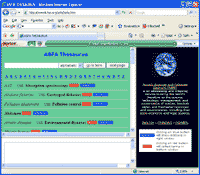
The ASFA Thesaurus is an indexing and searching tool. It contains the subject descriptors used to index the records which are contained in the Aquatic Sciences and Fisheries Abstracts (ASFA) bibliographic database. ASFA is an abstracting asfa_thesaurus.gifand indexing service covering the world's literature on the science, technology, management, and conservation of marine, brackish water, and freshwater resources and environments, including their socio-economic and legal aspects.

Link: ASFA thesaurus


Source: FAO ASFA web page ((Richard Pepe ( This email address is being protected from spambots. You need JavaScript enabled to view it. ), updated May 2005) )


Latest News

26 march 2024: vacancy consultant OTGA 2 Project Manager

The IODE Programme Component, OceanTeacher Global Academy is seeking a consultant for 8 months

Please find the requirements here

This contract would run from 15 April until 15 December 2024.

Deadline to apply is 31st March 2024  Extended till 7 April 2024- contact point: Mr Peter Pissierssens (This email address is being protected from spambots. You need JavaScript enabled to view it.) and This email address is being protected from spambots. You need JavaScript enabled to view it.


19 March 2023: OBIS secretariat now has two experts in eDNA

OBIS has a key role in several new projects that use eDNA or aim to further improve this technology for biological monitoring and we are glad to announce that we now have two knowledgeable staff members in our OBIS secretariat who are experts in eDNA: Dr Emilie Boulanger (consultant) and Dr Saara Suominen (project appointment).


Dr Saara Sumominen, after more than 3 years working as a consultant for us with projects like PacMAN and eDNA expeditions, now joined the OBIS secretariat on a project appointment contract basis to help implement 3 Horizon Europe projects (Marco-Bolo, eDNAquaPlan and DTO-BioFlow), coordinate the final scientific report of eDNA expeditions in UNESCO marine world heritage sites, and further develop the capacity to manage eDNA projects at OBIS.

Saara can be reached by email at This email address is being protected from spambots. You need JavaScript enabled to view it.

More information on Saara's background see: https://obis.org/2020/09/15/saara/


Dr Emilie Boulanger joined us as a consultant and will support us with implementing two Horizon Europe projects: Marco-Bolo and eDNAquaPlan. Some of these tasks include (i) reviewing protocols and SOPs utilized for eDNA monitoring, (ii) testing bioinformatic workflows and comparing outputs across marker and taxonomic types, (iii) establish standards for genetic reference libraries and eDNA data repositories, (iv) aligning databases for enhanced interoperability, and (v) addressing the infrastructure and services for aquatic biodiversity monitoring using eDNA.  

Emilie has a background in biodiversity conservation and marine molecular ecology. For her PhD at the University of Montpellier, her work focused on applying molecular methods to study the genetic and species diversity of fish populations and communities in the Mediterranean Sea. During her following PostDoc experience at the Aix-Marseille University, she applied her research experience towards teaching as well as developing monitoring projects coupling environmental DNA metabarcoding with direct species observations. She is passionate about the ocean, knowledge dissemination and projects that bridge scientific innovation with environmental conservation and policy.

Emilie can be reached by email at This email address is being protected from spambots. You need JavaScript enabled to view it.


20/4/2024: Former IODE Chair Dr J.R. (Ron) Wilson passed away

We received the news that Dr J.R. Wilson (Ron) has passed away.

Dr J.R. Wilson was Director of the Marine Environmental Data Service of the Canadian Department of Fisheries and Oceans. He was IODE Chair between 1992 and 1996 and chaired the 15th Session of the IODE Committee held in Athens, Greece. Dr Wilson was also GTSPP Project Leader and MEDS hosted the RNODC for drifting buoy data. Many of us remember Ron as a kind and very experienced colleague, always ready to advise and assist. 

We offer our condolences to Ron's family.

(picture of the IODE-XV Session with Ron behind the Chairman IODE sign) 

22 February 2024: Meeting of the IODE Management Group

The IODE management group meeting took place in Oostende, Belgium from 5-7 February 2024. The Summary Report is now available : https://oceanexpert.org/document/33860

background documents and presentations are available on https://oceanexpert.org/event/3991#overview

The following items were discussed during this 2.5 days meeting: the action points of the XVII meeting, the status of the IODE network , the restructuring of the IODE elements , the IODE Quality Management Framework, the different Programme elements achievements in the past year , the collaboration with other entities, IODE role in the UN Decade and new possible initiatives to come.


09 February 2024: Individual consultant ‘Stakeholder Engagement and Community Integration’ for the Marco Bolo project

OBIS is taking part in an EU-funded project, MARCO-BOLO (MARine COastal BiOdiversity Long-term Observations) which aims to structure and strengthen European coastal and marine biodiversity observation capabilities.

The main objective is to enable a digital framework for coastal and marine biodiversity data streams and data access. This will be done by building on international standards and approaches to establish the biological component of the marine
and coastal Earth observation Infrastructure in Europe. One of Marco-Bolo’s main aims is a more effective knowledge transfer and uptake of data and information products through the establishment of a stakeholder community and close engagement through co-design/co-creation workshops.

UNESCO-IOC is seeking an individual consultant to assist with the coordination of the Marco- Bolo project and more specifically the work related to Work Package 6 “Stakeholder Engagement and Community Integration”.

more information: HERE

Deadline to apply: 23 February 2024 (23: 59 CET)

contract start: 7 March 2024 - 75 % 

Quality Policy Logo

The IODE Meeting & Training Centre

Launchpad


Regions

ODINAFRICA
ODINECET


Upcoming Events

 
© 2024, UNESCO/IOC Project Office for IODE, Oostende, Belgium. - disclaimer