A number of Caribbean countries are embarking on an initiative to develop a Caribbean Marine Atlas (CMA). The purpose of the CMA is to identify, collect and organize available geo-spatial datasets into an atlas of environmental themes for the Caribbean region, under the sponsorship of the Intergovernmental Oceanographic Commission's (IOC) International Oceanographic Data and Information Exchange (IODE) and Integrated Coastal Area Management (ICAM) Programmes. The CMA will include geo-spatial data from national and regional projects and programmes, related to the sustainable development and integrated management of marine and coastal areas in the region. 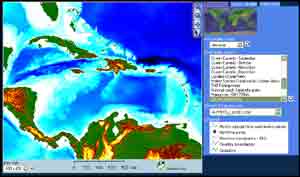
While these areas and their associated living resources are of major importance for the sustainable development of the Caribbean, they are under increasing pressure from a combination of anthropogenic and natural threats. A major constraint to effective integrated management of these areas has been limited availability of data and information as well as of appropriate data and information tools.
Visit the Caribbean Marine Atlas on http://www.caribbeanmarineatlas.net/
The IODE/ICAM WORKSHOP ON THE DEVELOPMENT OF THE CARIBBEAN MARINE ATLAS (CMA) was held in Barbados between 8 and 10 October 2007 to discuss the way forward with the CMA pilot project - MORE ABOUT THE WORKSHOP HERE
A prototype version of the Caribbean Marine Atlas will be prepared by nine participating countries (Barbados, Cuba, Dominica, Grenada, Guyana, Jamaica, St Lucia, Trinidad & Tobago and Turks & Caicos). It is expected the prototype Atlas will be released in October 2008. It is planned to extend the Atlas to include other countries in the region. Environmental datasets from organizations in the contributing countries will be collected for presentation in the Atlas.
Data Layers
The data layers for the Atlas will be:
- Regional Scale Data Layers - These layers cover the complete Atlas area of interest.
- National/Local Scale Data Layers - These layers cover specific countries in the Caribbean. It will be the responsibility of the participating countries to collect and organize data. Some of the data themes that will be included will be provided as "virtual" datasets.
- Virtual Data Layers - These layers will be provided as links to online web map servers (WMS) or web feature servers (WFS) that produce dynamic maps that can be integrated into the Atlas.
Features of the Atlas
he CMA will be a digital atlas comprising easily downloadable data on various key themes relevant to the marine and coastal environment of the Caribbean. Among these themes are coastal habitats, fisheries, environmental quality, climate change and sea level rise, oceanography, as well as socio-economic aspects. The Atlas will also contain dataset descriptions (metadata) and links to the source data. It is intended both to provide necessary datasets directly to concerned scientists, coastal zone management practitioners, and natural resource managers, and will set the stage for the development of decision-makers' toolkits that rely on geo-spatial information.
The CMA will play an important role in informing decision-makers on issues relating to the marine and coastal environment and it is envisaged the Atlas will become the main entry point for anyone interested in finding information on the coastal and marine environment of the Caribbean.
The development of the CMA will also provide a tool to assist community building and collaboration in the region. It will draw on national human resources to identify issues of concern, define appropriate indicators and locate datasets that can be used in the atlas. In addition, data gaps that require additional resources will be identified. As part of the Atlas development, the IODE programme will provide the necessary training to the relevant persons from each country. The CMA will be built using open source technologies and will be based on international standards to enable the sharing of technological knowledge and resources. The Atlas will encourage the wide dissemination of key datasets by providing access and visualization of these data.
- Details
-
Created on: Wednesday, 17 October 2007 14:25
-
Last Updated on: Monday, 01 July 2013 12:20