|
|
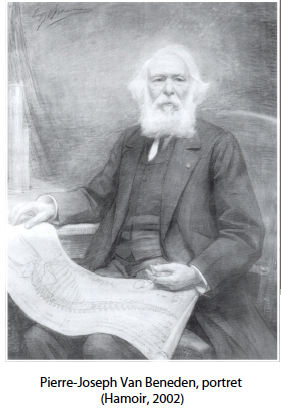 In 1843 professor Pierre-Joseph van Beneden from Leuven installed the world’s very first marine research station in Ostend. In doing so the Belgian professor was ahead of his time and of a wave of similar stations elsewhere in Europe and the world, and would lay the foundation of a long tradition of marine institutes in Ostend. A meticulous study of historical source material now also shows the exact location of this Belgian world first, which has since disappeared. This fact is celebrated on 25 June with the unveiling of a commemorative plaque at the façade of VLIZ and some explanation on the occasion of the launch of the ‘Zeekrant 2010’ newsletter. In 1843 professor Pierre-Joseph van Beneden from Leuven installed the world’s very first marine research station in Ostend. In doing so the Belgian professor was ahead of his time and of a wave of similar stations elsewhere in Europe and the world, and would lay the foundation of a long tradition of marine institutes in Ostend. A meticulous study of historical source material now also shows the exact location of this Belgian world first, which has since disappeared. This fact is celebrated on 25 June with the unveiling of a commemorative plaque at the façade of VLIZ and some explanation on the occasion of the launch of the ‘Zeekrant 2010’ newsletter.
It is a well-kept secret, but Belgium can be proud of having founded the very first marine research station in the world. It was professor Pierre-Joseph van Beneden (1809-1894) from Leuven who built a modest laboratory with private means on the east bank of the port of Ostend in 1843. This “laboratoire des Dunes”, which was located on the grounds of the Valcke-Deknuyt oyster farm and belonged to his in-laws, would be the scene of a great deal of marine biological research and the reception of various renowned Belgian and foreign researchers over the following decades. Here, Van Beneden would also lay the foundation for his pioneering research on (fish) parasites and on the animal life of the Belgian coast. Near the Ostend fish market, hundreds of fishing vessels and dozens of oyster tanks (“huîtrières”) always ensured him of the supply of sufficiently fresh study material.read more
With
this action he inspired the many reputable stations that sprang up all
over
Europe from the second half of the 19th century onwards
(Concarneau
1859, Roscoff 1872, Naples 1872, Wimereux 1875, Den Helder 1890). His son Edouard van Beneden (1846-1910)
followed in his father’s footsteps and became – in addition to perhaps
the
greatest Belgian biologist of all time thanks to the discovery of
meiosis or
reductional division – the main driving force behind oceanography at the
University
of Liège. He also founded a
research station in Ostend (1883). However,
it was a disciple of his father, Gustave Gilson, who first set
up his own field laboratory not far from the aforesaid stations and
subsequently
became director of the Marine Scientific Institute (ZWI), established in
1927. In 1970 the ZWI was succeeded by
the Institute
for Marine Scientific Research (IZWO), which was in turn incorporated
into the
new Flanders Marine Institute (VLIZ) in 1999. Nowadays the VLIZ offices in Ostend overlook what
was
once the world’s first marine research station. So things have come full circle.
Nowadays
nothing remains of the actual research station from 1843. At the end of the 19th century it
lost its appeal and eventually it was sacrificed to the expansion of the
harbour channel. A commemorative
plaque will be unveiled on Friday 25 June on the occasion of the annual
open
members’ day of the Flanders Marine Institute (VLIZ). The programme also includes an outline of the
history
of marine sciences in Belgium, the launch of the new ‘Zeekrant 2010’
newsletter
and the presentation of the modernised marine library.
Press
invitation:
The
press has the chance to attend the public part of the VLIZ members’ day,
which
includes the following items:
- 2 pm – 2:10
pm:
launch
of Zeekrant 2010 (Guido Decorte, member of the Executive Council of
West
Flanders)
- 2:10 pm – 2:30
pm:
“Intriguing
marine heads” (Evy Copejans)
- 2:30 pm – 3
pm:
“The
history of Belgian marine sciences has come full circle” (Jan Seys)
- 3
pm – 3:15
pm:
Unveiling
the commemorative plaque for the first marine research station (Jan
Mees)
- 3:15 pm – 4
pm:
“A
plunge into the modernised marine library” (Jan Haspeslagh &
Heike
Lust)
The
event takes place on Friday 25 June 2010 from 2 pm to 4 pm in the
VLIZ offices, Wandelaarkaai 7, 8400 Ostend (Belgium).
Press
contact: Jan
Seys – Mobile:
0478/37 64 13; This email address is being protected from spambots. You need JavaScript enabled to view it.
- Details
-
Created on: Thursday, 24 June 2010 19:45
-
Last Updated on: Monday, 01 July 2013 12:20
|
|
|
|
|
© 2024, UNESCO/IOC Project Office for IODE, Oostende, Belgium. -
disclaimer
|
|