The African Marine Atlas developed by the Ocean Data and Information Network for Africa (ODINAFRICA) was officially launched on 23 February 2007 at the IOC Project Office for International Oceanographic Data and Information Exchange (IODE) in Ostend, Belgium.
The African Marine Atlas, which can be accessed at http://www.africanmarineatlas.net, provides substantial maps, images, data and information to coastal resource managers, planners and decision-makers from various administrative institutions and specialized agencies in Africa. The Atlas will be of immense benefit to national institutions and a variety of users such as environmentalists, local administrators, park managers, scientific community, fishing cooperatives, tourists, hotel keepers, teachers, NGOs, the general public, and any other interested persons. It has over 800 downloadable data products 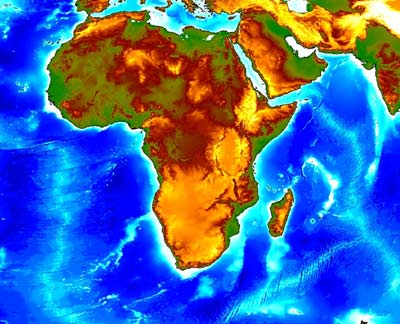 derived from the fields of marine geo-sphere, hydrosphere, atmosphere, biosphere, geopolitical and the human socio-economic dimensions.
The Atlas indicates areas of intense use along the coastline requiring careful management and provides potential foresight on likely consequences of specific decisions. Further, the Atlas indicates gaps in knowledge and information base, where additional efforts may be directed. The Atlas will also act in other ways as a guide to recreational opportunities and tourist attractions.
In developing the Atlas, the main objective was to collate available geospatial datasets and information on the marine environment and to summarize it into an African Marine Atlas suite.
The website is one of a set of Marine Atlas products that will include web data services, web mapping and an Atlas publication when completed.
The Atlas was realized through intensive work between May 2006 and February 2007 by a team of 16 marine scientists and GIS experts from NODC’s in Benin, Ghana, Kenya, Mauritania, Mauritius, Mozambique, Namibia, Senegal, Seychelles, South Africa, and Tanzania. International ocean data experts provided key inputs in data analysis. It is based on an extensive survey of coastal and marine data needs undertaken in early 2006 in all the countries participating in ODINAFRICA.
Primary partners in this project were the United Nations Environment Programme (UNEP), and the African Coelecanth Ecosystem Programme (ACEP). UNEP will develop a clearinghouse and information system on coastal and marine resources of Eastern Africa from the regional atlas. The Atlas has brought great benefits to participating national institutions and Africa as a whole, by encouraging scientists to work together, learn new techniques, and build teams that will continue to regularly update the Atlas with national and local scale data sets.
African Marine Atlas Coverage
Using published and unpublished sources, hundreds of basic datasets – many of them global in scope – were painstakingly edited down to an agreed upon area of interest for the African continent, converted to special Geographic Information System (GIS) formats, documented, and then posted on the AMA website (above). AMA takes the form of an online library of GIS-compatible data, in the following areas:
| Atlas Themes |
Data Products |
|
GEOSPHERE
|
19
|
|
HYDROSPHERE
|
445
|
|
ATMOSPHERE
|
96
|
|
BIOSPHERE
|
231
|
|
HUMAN ENVIRONMENT
|
27
|
|
BASE MAP
|
61
|
BASE MAPS
The Atlas is built around a comprehensive set of fundamental “base maps” and geographically registered “base images” that can be used with datasets as overlays. These data include several different coastlines (of varying resolutions), as illustrated by the two examples of the Capetown area, below. The example on the left is the lowest resolution dataset (for easy, quick plotting), while the example on the right is from the highest resolution dataset.
Other data in the Base Maps group include all the depth contour lines from the GEBCO Atlas, a very good gridded bathymetry/topography dataset (shown by the example figure of the Namibian coastline on the right), a gazetteer of ocean place names, and an extremely high-resolution “land mask” for use with satellite images.

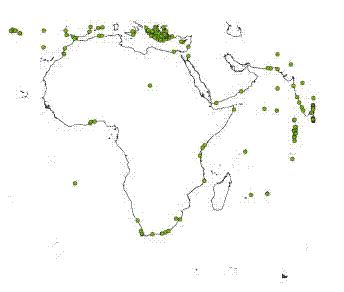
GEOSPHERE. The geological area is represented in the Atlas by data covering geohazards (especially including tsunamis, as shown by the figure below left here of tsunami runup sites), minerals and core sampling sites (which can be linked back to the original data), sediment thickness (a primary parameter in Law of the Sea considerations), land cover and soils.
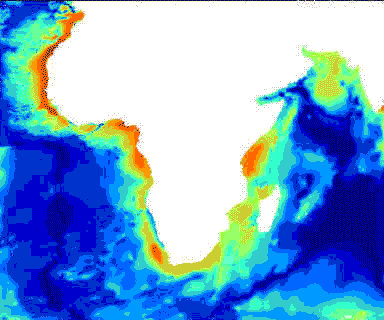
As mentioned, there are important legal implications to sediment depths, making these data of high interest. Shown here in light brown, the areas of deepest sediments tend to mirror areas of high productivity (picture above, right).
HYDROSPHERE. Ocean and fresh waters are represented in the Atlas by numerous themes. In the areas of Physical Oceanography, temperature, salinity, sea surface temperature, average currents and sea level records are covered. For Chemical Oceanography, the basic nutrients fields are provided. In Optics (an area not often well populated with data) the incoming light and the light field characteristics for photosynthesis are provided by climatological fields. At present only gridded runoff data are provided for Limnology. Uniquely, the Atlas includes the possibility to compare exactly equivalent analysis from different sources of the average currents around the continent, as shown by the following three figures. Each of these is meant to portray January surface current vectors at the same scale. The apparent differences, even at this small scale, will be the subject of much debate and discussion, one of the aims of the Atlas.

ATMOSPHERE. Weather and climate are well represented in the Atlas. The fundamental theme areas are temperature, pressure, humidity, precipitation and cloudiness. Winds, storm tracks and storm zones are under construction.
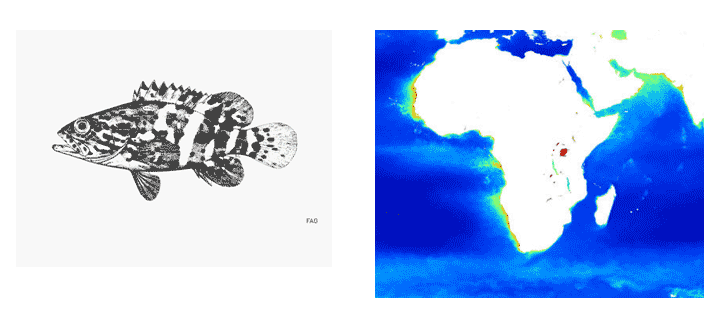
BIOSPHERE. The plants and animals of the African continent represented a huge challenge to the AMA team, because many of the distribution patterns of important species had never been mapped and/or the existing data had not been synthesized for mapping. Using an extensive network of contacts they developed, the Biosphere Team developed data in the following areas: Phytoplankton, Chlorophyll, Zooplankton, Algae & Kelp, Mangroves, Vegetation (land), Fishing Areas, Total Catch/Aquaculture, Species Catch & Distributions (selected countries), Corals, Fishes, Invertebrates, Protected Areas, Exotics & Invasives and IUCN Red List Species. In addition, although downloadable files are not provided, there are links to other data sites covering Mammals, Reptiles and Birds. This critical area of the Atlas benefited greatly from the participation of the African Coelacanth Ecosystem Programme (ACEP). The figure below, on the left, is the critically endangered Giant Grouper, from the IUCN Red List, an example of the figures provided in the Atlas, along with GIS maps of distribution. The figure below on the right shows the annual average concentration of chlorophyll in the surface waters, with highest values shown in reddish-brown. The areas of upwelling are clearly indicated
HUMAN ENVIRONMENT. The most complex area to cover in this ambitious project was the area of social, economic and environmental impacts from man’s activities. In this area, AMA was greatly assisted by the involvement of the United Nations Environment Program, in particular the UNEP’s ambitious national-level GIS projects along the African coast. Themes in this area proved to be among the most difficult targets, due to their possible commercial uses, which tend to lock them into copyright situations. The Atlas currently contains data in the areas of Country & Internal Boundaries, Exclusive Economic Zone (EEZ) Boundaries, Maritime Features (see Ports figure, below), Population, Industrial & Commercial (entities with possible impacts on the coastal zone), Transportation (multiple modes), Energy Transmission and Coastal Hospitality/Tourism.

The African Marine Atlas will continue to be augmented with new datasets, as the partners discover and convert them to GIS formats, a considerable undertaking. Participants in the AMA initiative include representatives from UNEP, ACEP and data managers from Benin, Ghana, Kenya, Mauritania, Mauritius, Mozambique, Namibia, Senegal, Seychelles, South Africa, Tanzania and the USA.
For more information, please contact:
Mika Odido
Email : This email address is being protected from spambots. You need JavaScript enabled to view it., This email address is being protected from spambots. You need JavaScript enabled to view it.
- Details
-
Created on: Saturday, 16 December 2006 18:36
-
Last Updated on: Monday, 01 July 2013 12:20