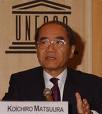
 Koïchiro Matsuura , Director-General of UNESCO today addressed the IOC Executive Council at the occasion of the opening of its 41st Session, taking place at UNESCO's Headquarters in Paris between 24 June and 1 July 2008. You can listen to Mr Matsuura's speech HERE (mp3 format) .
Read more HERE
The Director-General began his intervention by
commending the Working Group on the Future of IOC, which met in Paris this past February
to identify options for enhancing IOC’s status and role. “I am
pleased to note that the Working Group agreed that the future of IOC should
unquestionably remain, and be reinforced, within UNESCO. This is something
I feel very strongly about, as do UNESCO’s Member States.”
He went on to note that an important consideration
for IOC in the future would be how to strengthen the Commission’s
role within UNESCO in terms of intersectoral and interdisciplinary
cooperation, drawing on IOC’s strong technical expertise in the ocean
sciences, ocean services and capacity development.
The Director-General underscored that “multidisciplinarity
is indeed one of UNESCO’s great assets in addressing complex
scientific and societal issues in the field of the environment, including
those related to climate change.” In this regard, he noted that IOC’s
work was clearly pivotal to UNESCO’s climate change strategy.
Mr Matsuura recalled that “IOC has
contributed significantly to building, and constantly improving, the global
knowledge base on climate change, underscoring the key role that oceans
play in regulating climate. Here, I should highlight in particular
IOC’s support to the World Climate Research Programme and its input
to the work of the Intergovernmental Panel on Climate Change.”
He noted that IOC, by coordinating the regular,
real-time gathering of ocean data through the Global Ocean Observing
System, also performed an essential function under the United Nations
Framework Convention on Climate Change and the Kyoto Protocol.
The Director-General then focused on the progress
that had been made four years after the Indian Ocean
tsunami, in establishing tsunami warning systems in all four oceans. He
underscored that this was “a remarkable and truly collective
achievement” of Member States with IOC’s support.
Mr Matsuura noted that “the Indian Ocean tsunami highlighted again the need for
national governments, and their populations, to be aware of and prepared
for the threat of natural ocean-related hazards… Recent disasters
tragically underscore the need to develop fully functional end-to-end
warning systems, which include timely and dedicated measures to enhance
communication, awareness and preparedness at all levels in Member States.
This is vital in order to save people’s lives and livelihoods in the
event of a disaster.” The Director-General then underlined the
important work being done by IOC to build capacity in Member States in the
field of ocean sciences, notably in Africa, for example through training to
develop inundation maps for marine related hazards, in which twelve
countries participated, including seven African states bordering the Indian
Ocean.
The Director-General also highlighted the work
being done by IOC, in cooperation with UNEP and the UN Division for Ocean
Affairs and the Law of the Sea (DOALOS), to assist Member States, notably
in Africa, in exercising their rights and responsibilities to determine the
outer limits of their continental shelf under the Law of the Sea Convention
Mr Matsuura underscored the importance of securing
extra budgetary funding for IOC, and invited Member States
to consider their voluntary contributions to IOC through the Additional programme of targeted/projected
extrabudgetary activities under which IOC had prepared a number
of proposals.
He concluded his intervention by looking forward
to hearing the Executive Council’s proposals for activities to
celebrate, in Paris
and worldwide, the first 50 years of the Commission in 2010.
“This will be an occasion to take stock of
the great achievements of the Commission, but also to look forward to the
challenges ahead. Today, more than ever, we measure the importance of
IOC’s contribution to achieving safe and sustainable development. Let
us therefore be bold in our vision for this important anniversary, and
together set the stage for another 50 years of scientific excellence and
leadership,” he added.
- Details
-
Created on: Tuesday, 24 June 2008 17:13
-
Last Updated on: Monday, 01 July 2013 12:20